
Identity, loyalty, financial services and agents: payment providers are seeking a bigger role in the shopping journey.
The setting. NRF Europe is the European edition of the major New York retail event. Held at Paris Expo Porte de Versailles, its second edition brings together retailers, brands and technology providers for three days of conferences and exhibitions. Official event overview ↗
Our take: many conversations focus on practical problems — making better use of inventory, supporting staff, streamlining payments and delivering on customer promises. AI cuts across these topics, but data quality and the way teams work remain crucial.
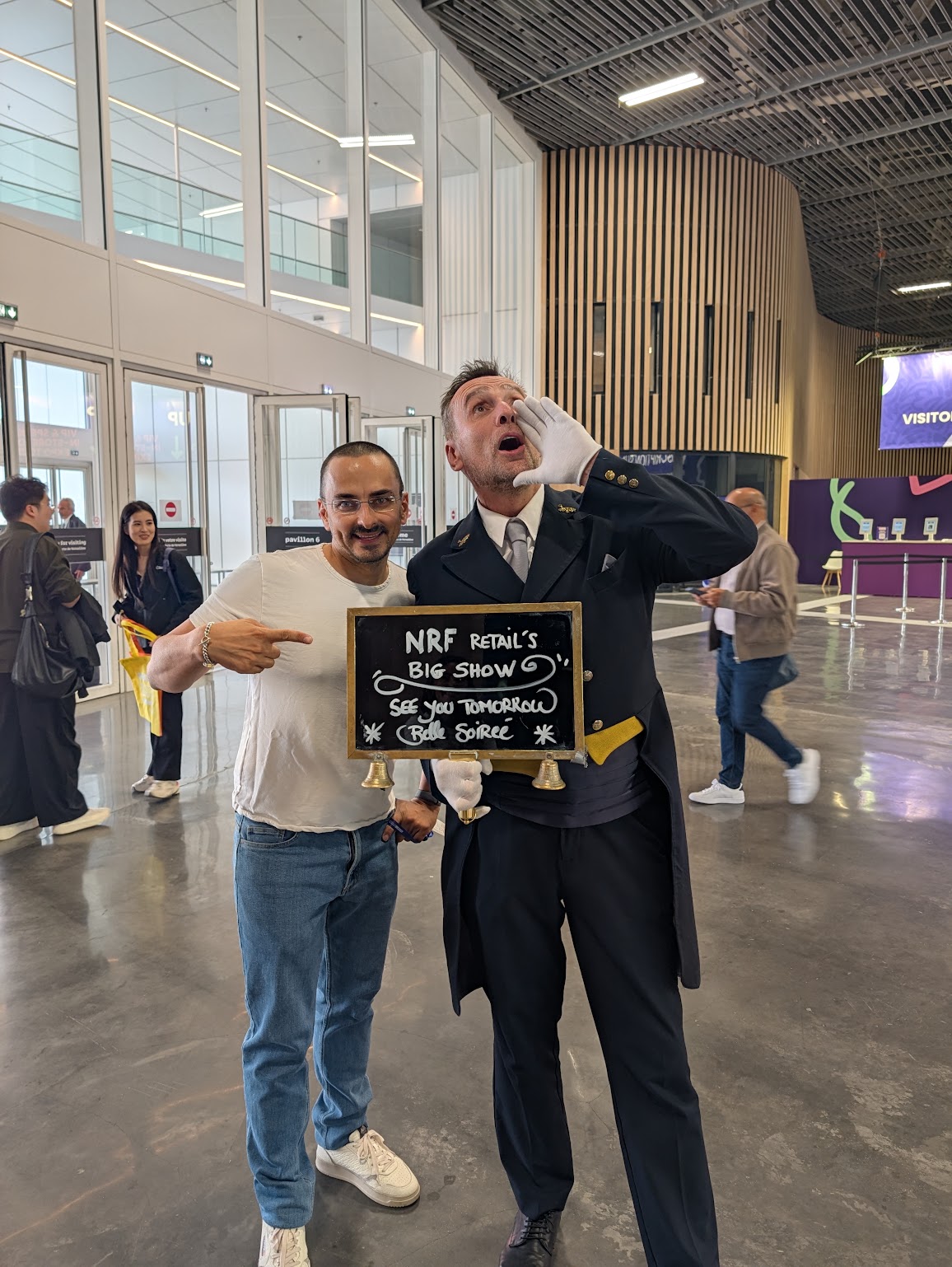
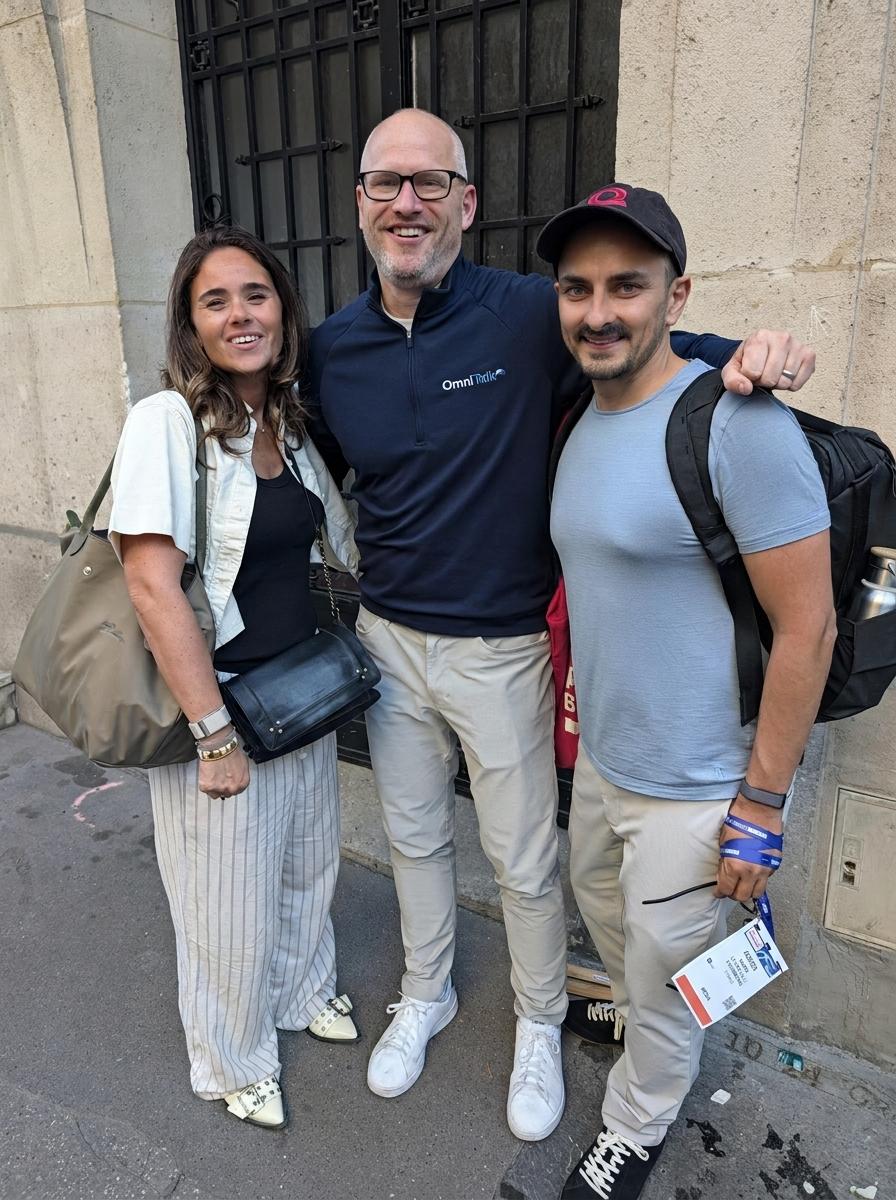
Behind the scenes.
Retail, with a human touch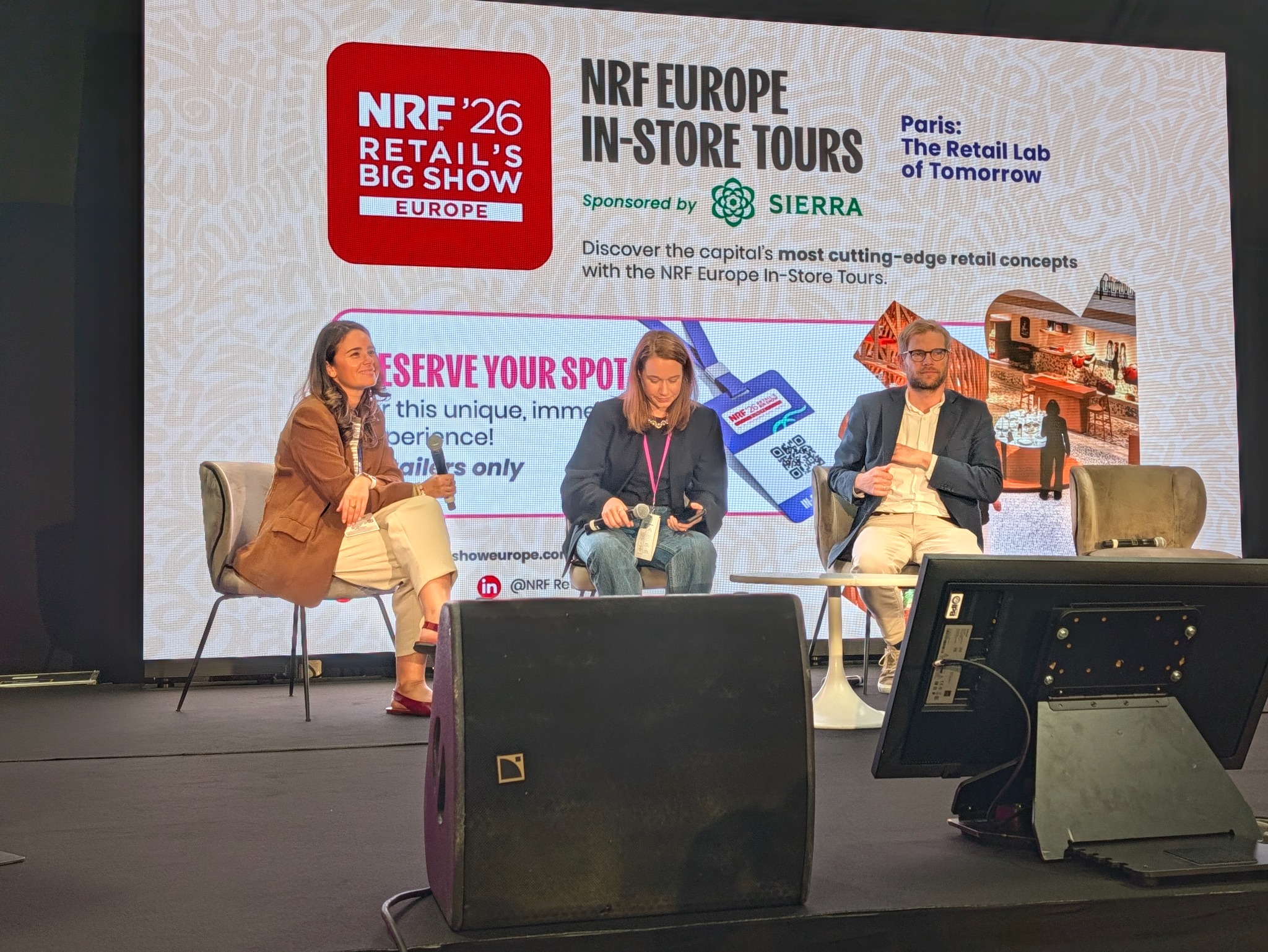
CRM, training, product information and orders: the use cases discussed go well beyond shopping assistants.
The M&S example shows that changing tools also means changing ways of working.
Six trends, concrete examples.
Why it matters01 / PAYMENTS
Taking payment is no longer the whole story.
In our interviews, Adyen connects payments, unified commerce and embedded financial services. Purse brings identity and payment orchestration together. BPCE Merchant Services / Payplug highlights omnichannel services and preparations for Wero and agentic commerce.
The programme reflects this shift: Worldline and Cdiscount discuss agentic commerce, while Paytweak explores the case for investing in physical stores.
Our takeThe competition also involves customer identification, transaction data and enabling agents to pay. Comparing payment fees alone no longer tells the whole story.
LCDE interviews: Édouard de Raulin, Pascal Roche, Antoine Grimaud. Programme: Worldline × Cdiscount · Paytweak.
02 / AI AGENTS
The first user may be an employee.
Zipline presents Zip Coach as a way to turn best practices from top-performing stores into recommendations for the wider network. Splio and SNCF Connect have a session dedicated to an agent designed for CRM teams.
On the retailer side, The Vitamin Shoppe advocates AI that helps store advisers access product information, according to Ecommerce Magazine’s conference report.
Our takeStart with a specific task: finding information, preparing an action or understanding a problem. Then measure both the time saved and the quality of the work.
LCDE interview: Dustin Sundy, Zipline. Splio × SNCF Connect session · Ecommerce Magazine report, 16 September.
03 / DATA & UNIFIED COMMERCE
Agents bring us back to the basics.
Kibo makes the case for integrating its e-commerce engine with its OMS, the order management system. The approach described in our interview connects AI models via MCP to query orders and understand operational issues.
At AMI Paris, the conference report puts product knowledge, inventory accuracy and stock location first.
Our takeAn intelligent interface won’t fix inaccurate stock data. Before letting an agent act, you need to know what data it uses, how reliable it is and which actions it can trigger.
LCDE interview: Lawrence Roycroft, Kibo. AMI Paris: Ecommerce Magazine report.
04 / DELIVERY
Logistics becomes part of the buying decision.
Ingrid connects pre-purchase delivery options, parcel tracking and returns. Sam Gibbons describes agents that can personalise delivery suggestions and make it easier to add or replace carriers.
The issue starts before the customer clicks ‘buy’: which options should you offer, at what price and with what promise?
Our takeConversion, delivery costs and on-time performance should be managed together. Optimising just one can come at the expense of the other two.
LCDE interview: Sam Gibbons, Ingrid. Capabilities described by the company; performance gains were not measured in our coverage.
05 / STORES
The shelf becomes a media space and a place for automation.
Solum describes electronic shelf labels evolving into devices that combine pricing, interactive content and retail media. The equipment also generates data to support store operations.
Looking further ahead: HIVE Robots is on the programme with humanoid shelf-replenishment robots offered as a service.
Our takeTwo priorities meet here: better communication in the aisles and the automation of physical tasks. Both should be judged on the value they create in stores, not their ability to impress.
LCDE interview: Gary Guillier-Marcellin, Solum. HIVE Robots programme entry: we have not verified a large-scale rollout.
06 / ROLLOUT
Reaching scale takes years.
The M&S Food and RELEX case offers a concrete reference point: a pilot in November 2021, followed by coverage of all products in March 2025. More than three years to roll out machine-learning-based forecasting and replenishment.
The account also highlights changes in working practices. Installing the system without changing how teams worked would not have delivered the expected benefits.
Our takeThe question to ask after the demo: how long, with which dependencies and what operational changes, before it delivers results at scale?
Conference reported by Miya Knights, Retail Technology, 15 September. No ROI figure is cited because the report does not provide a documented measurement.
The show by business categoryA fintech show?
23%
A fintech show?
That’s an oversimplification.
23%of the directory entries we analysed relate to payments, financial services and checkout, including POS systems, payment terminals and cash handling.
In-store technology, equipment and security account for almost as much. Marketing, inventory and e-commerce also have a significant presence.
Our classification of 287 directory entries consulted on 16 September. It describes this dataset, not booth size, visibility or a certified count of exhibitors attending.
| Primary activity | Share of dataset |
|---|---|
| Payments, financial services & checkout | 23.0% |
| In-store technology, equipment & security | 22.6% |
| Marketing, CRM & retail media | 15.7% |
| Inventory, logistics, planning & pricing | 12.9% |
| IT, data, consulting & HR | 8.7% |
| E-commerce, discovery & conversion | 8.0% |
| Other & unclassified | 9.1% |
One primary activity per entry, with no double counting. Twenty entries lack sufficient information and remain in ‘other & unclassified’. Exhibitor directory ↗
Three questions to take back to the office.
- Which specific friction are we trying to remove? Finding information, an out-of-stock item, a declined payment or a missed delivery promise.
- What is already working for a comparable customer? Ask what is in production, what results have been measured and what limitations have emerged.
- What do we need to change internally? Data, integrations, responsibilities and training: the real cost of a project goes beyond the price of the tool.
Reading between the lines.
What was observed, presented or announced
This recap combines summaries of seven LCDE interviews, the event programme, our classification of the exhibitor directory and two journalistic conference reports. Interviews describe companies’ offerings and positions; they do not independently validate their performance. Conclusions labelled ‘our take’ are editorial analysis.
A session’s inclusion in the programme does not mean we attended it. This recap covers a selection of topics, rather than every conference session at the show.
Before the event, organisers announced more than 12,000 expected attendees, over 60 countries, 200 speakers and more than 100 sessions. These were advance announcements, not verified attendance figures. Press release, 26 February 2026 ↗
The technology, without the jargon
AI agent. Software that can carry out sequences of tasks and use tools, with a level of autonomy that needs to be defined.
Unified commerce. Connecting data and operations across websites, stores and other channels to provide a consistent customer journey.
OMS. The system that organises order management and fulfilment.
MCP. A protocol used to connect AI applications to tools and data.
Payment orchestration. Coordinating multiple providers and rules to process payments.
In-store retail media. Advertising space or brand content displayed within a store.
The interviews behind this recap
Dustin Sundy (Zipline), Édouard de Raulin (Adyen), Sam Gibbons (Ingrid), Gary Guillier-Marcellin (Solum), Antoine Grimaud (BPCE Merchant Services / Payplug), Pascal Roche (Purse) and Lawrence Roycroft (Kibo). Summaries drawn from the preparation of episode 277 of Le Café de l’E-commerce; no reconstructed quotes.